


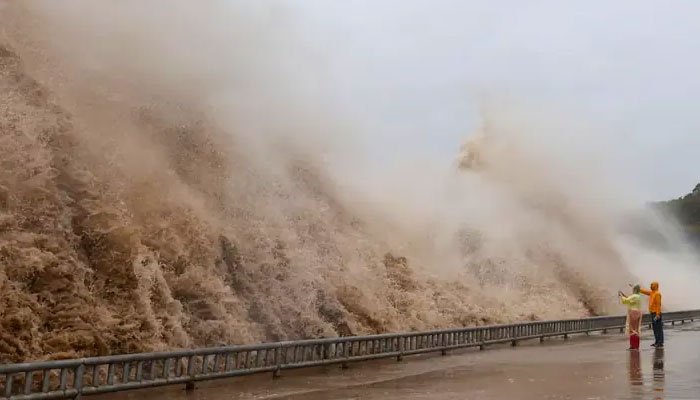
Typhoon Dolphin, the strongest typhoon of the year, has hit China’s east coast, bringing torrential rain and strong winds to coastal areas. Warnings of flooding and landslides have been issued after the storm made landfall.
The storm had previously hit Japan’s southern prefecture of Okinawa, injuring six people and knocking out power to more than 50,000 buildings.
According to China’s meteorological agency, Typhoon Dolphin made landfall near Yuhuan in eastern Zhejiang province at around 5:30 p.m. Sunday. The storm’s center was packing winds of 42 meters per second, or 151 kilometers per hour, equivalent to a Category 1 storm on the Ambassador Simpson scale.
In view of the storm threat, authorities had already evacuated workers working far from the coast to safer places, recalled ships to ports and tightened surveillance at dams, mountain streams, landslide-prone areas and tourist attractions.
The meteorological department warned that heavy rains could hit Zhejiang, Shanghai, northern Fujian, northeastern Jiangxi, central and southern Anhui, and most parts of Jiangsu until August 10, while parts of Zhejiang could see 250 to 500 millimeters of rain.
Wang Haiping, chief forecaster at the National Meteorological Center, told state broadcaster CCTV that Typhoon Dolphin is expected to move westward after hitting the coast, after which it will slow down over central and southwestern China and gradually weaken.
Wang Haiping said the situation could lead to longer periods of heavy rain and an increased risk of flooding and landslides, especially in mountainous areas and around small rivers.
The storm has disrupted the entire transportation system in the eastern part of the country and has forced more than a million people to evacuate their homes. More than 30,300 people have been evacuated from Shanghai alone, and flight tracking data shows about 1,500 flights have been canceled.
A 42-year-old tourist from Guangdong province, surnamed Chen, said his flight was canceled on Sunday and he and his family were stranded in Shanghai due to the storm.
“We have now received a ticket for a 10pm flight on Monday, but we are not sure whether the plane will be able to take off,” Chen told Reuters.
He added that for us Guangdong people, this storm is as common as eating food and feeling the wind, it is part of our daily lives, because the storm does not feel very strong compared to China’s southern coast.
On the other hand, Wenzhou, a city in neighboring Zhejiang province, has evacuated more than 900,000 residents to safe places and set up more than 1,000 emergency shelters.
According to Xinhua News Agency, authorities have evacuated 98,900 people from dangerous areas after raising the storm emergency alert to level three in Fujian province. Level three alerts are also in effect in Shanghai, Zhejiang and Jiangsu.
Fujian maritime authorities said that 55 coastal passenger ferry routes have been suspended, all 115 construction projects underway at sea have been stopped and 290 construction ships have been moved to safer waters.
The Ministry of Water Resources has issued an alert that major flooding is possible in the Qiantang, Yong, Jiao and Shuiyang rivers, while the Shanghai Maritime Safety Administration said that large ships have been removed from Yangshan Port and more than 500 small and medium-sized ships have been moved to safety.
Citizens have been instructed to strictly follow the orders of local authorities.
