


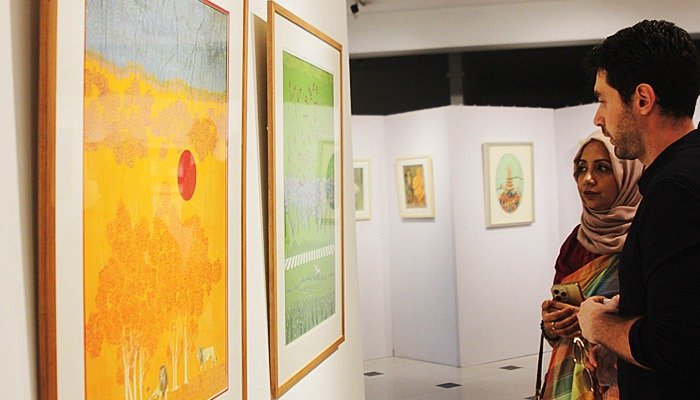
“SAAT KAHANIYAN – AIK SATH” An exhibition titled “Saat Kahaniyan, Aik Sath (Seven Stories, Together)” opens today (Thursday, 13 August 2026) at Gallery 6 Islamabad. This group exhibition brings together seven artists working within the Indo-Persian miniature tradition, each now pulling that inheritance in a different direction. The artists are Ali Gilani, Bakhtawar Naqvi, Hifza Khan, Onaiz Taji, Ramsha Rubbani, Safwan Bashir, and Samreen Asghar.
Discussing the show, Sadia Gul, curator of the exhibition, stated that painting has always been a discipline of restraint before it is one of detail. The wasli, the hashiya, and the fine kalam line are all inherited rules that each artist in this exhibition has chosen to keep, break, or quietly reinterpret. What unites the seven is not a shared subject but a shared instinct: to use an old, exacting language to ask something urgent about the present.
Samreen Asghar is a faculty member at COMSATS University and is the most senior practitioner in the exhibition, with over two decades of practice. She draws from Kangra, Pahari, Persian, Chinese, and Japanese traditions. Her work envisions nature not as a passive backdrop but as an active witness. She extends miniature’s craftsmanship onto larger surfaces, while her subjects propose survival as a collective condition sustained through reciprocity and care between humans and the more-than-human alike. Her four artworks, titled Liminal, Oracle, Confluence, and Commons, are all likely to attract substantial attention from art lovers.
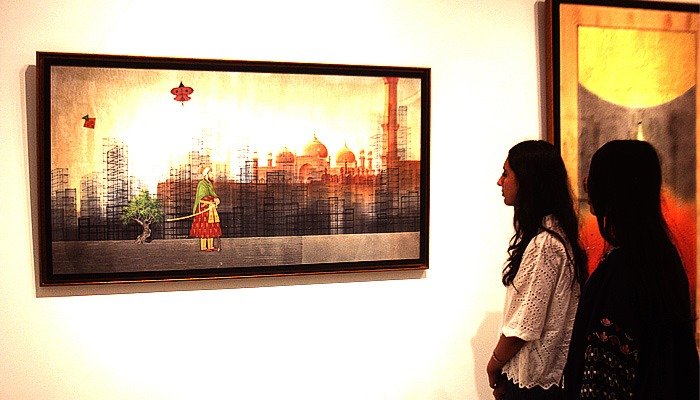
Safwan Bashir was the winner of the Second Prize at the National Biennial Arjumand Painting Award in 2023. His work continues to draw attention to the destruction of nature by human beings. In the artwork “Where Birds Once Flew”, he presents a Mughal king amid modern high-rise scaffolding rendered as cages, wondering where all the gardens and greenery have gone, while a small tree and a single kite flying overhead mark what little of the natural world still finds room to breathe.
Ali Gilani’s artworks have been exhibited internationally in Abu Dhabi, Dubai, Manchester, and Moscow. The works in this exhibition are from the series “Blind Faith”, which renders the shared narrative of Abraham, held in common by Islam, Christianity, and Judaism, showing how faith inspires resilience, compassion, and ethical living. He works in archival ink and gold leaf, treating faith as a framework for meaning amid technological and social upheaval. His works “The Vessel of Salvation”, executed in blue, gold, and black, and “The Furnace of Faith”, executed in red, black, and gold, are likely to attract collectors’ attention.
Bakhtawar Naqvi’s artwork centres on borders, patterns, and figures in mundane settings, drawing on the hashiya of traditional miniature—the border that protects the central subject while also limiting it. She is drawn to the way windows and gates are covered in lattices and fencing, creating tension between access and enclosure, like a line of control that lets air in but restricts passage. Her simple but powerful line drawings of everyday life reveal the power dynamics embedded in domestic and social environments.
Hifza Khan’s practice explores women’s emotional landscapes through a dialogue between the body, nature, and cultural memory. She constructs imagined environments where botanical forms, birds, braided hair, and architectural elements become symbolic languages through which questions of belonging, displacement, freedom, and resilience unfold. Nature is not simply represented in her work; it becomes an active collaborator. Roots, branches, flowering plants, and organic growth mirror the cycles of endurance, care, and regeneration that shape women’s lives. Recurring motifs such as birds, pomegranates, and braided forms function as metaphors for migration, memory, fertility, continuity, and transformation, as seen in “The Anatomy of Home”. Rich colour and intricate surface detail create an emotional terrain where vulnerability and strength coexist, allowing personal narratives to resonate as collective experience.
Onaiz Taji is inspired by the “kalam”, or line work, which defines the characteristics of the people in his artworks. He investigates large numbers of people gathered together in a disorganised or unruly manner, but shows particular interest in dealing with individuals. The whole image resembles organic shapes or patterns, but upon closer inspection, the thousands of smaller units—the individuals—do not lose their organic quality. In the macro sense, their placement deeply affects the feel of every artwork and reveals new aspects to consider with every viewing. “Majma” and “Tangled” are interesting examples.
Ramsha Rubbani’s current series of work reveals the bitter reality of change in nature—not only in human beings but in every single thing in the environment, whether it is a seasonal change or a change in human behaviour. Her artworks titled “A Timeless Thread” takes women’s biological and emotional changes as its foremost inspiration, balancing chaos and order in a body of work that often settles on the bond between mother and child.
Art lovers in Islamabad and Rawalpindi will have the opportunity to view “Saat Kahaniyan, Aik Sath” at Gallery 6 in F-6 Markaz till 17 August 2026.
