



Beyond the Killer Mountain: 5 Mind-Bending Realities of Nanga Parbat and the Fairy Meadows
Introduction
In the high-altitude theatre of the Himalayas, few names evoke as much cognitive dissonance as the Fairy Meadows. To the uninitiated, the name suggests a gentle, pastoral idyll. Yet, this lush plateau sits in the literal shadow of a colossus with a far darker reputation: Nanga Parbat, known globally as the Killer Mountain. Standing at 8,126 metres, this peak is the sentinel of the Indus, the western anchor of the entire Himalayan range, where the earth suddenly terminates in a vertical desert of ice and rock. It is a place of staggering contradictions, where a serene alpine sanctuary serves as the gateway to a peak that has claimed lives with terrifying consistency. Perhaps the greatest curiosity, however, is the accessibility of this encounter. How can one of the world’s most lethal 8,000-metre giants—a place that has historically broken the world’s elite—be reached by ordinary travellers on a mere day-hike?
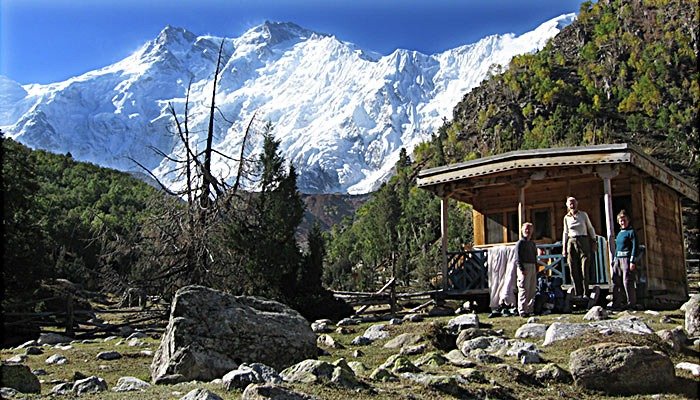
The Fastest Growing Giant on Earth
The etymology of Nanga Parbat is as stark as its ridges. Derived from the Sanskrit Nagna Parvata, it translates to the Naked Mountain—a reference to the sheer, vertical reaches of its south face that are too steep to hold the winter snows. While its name is ancient, its physical stature is remarkably restless. Geological data identifies Nanga Parbat as the fastest-growing mountain on the planet, thrusting skyward at a rate of 7 mm per year. This geological restlessness means the peak is rising nearly twice as fast as Mount Everest, birthing new terrain faster than the history of its conquerors can keep pace.
Despite being the ninth-highest mountain on Earth, it ranks fourteenth in global prominence. This is due to its profound isolation; it stands as a singular monolith, separated from the Karakoram giants to the north by the deep, scorched trench of the Indus River. This isolation creates a visual scale that is almost impossible to comprehend from the valley floor.
“Before starting back down to the drowsy world of Gilgit, there is more to be seen. Turn back from the peaks of the Karakorams, and face due south. Here lies the true horror of the Himalayas. This time there is no deep and distant perspective; the horizontal is unrepresented. You are staring at a wall; it rears from the abyss at your feet to a height for which the neck must crane back. Such is Nanga Parbat, the Naked Mountain.”
The Solo, Drug-Fueled Marathon of the First Ascent
The history of Nanga Parbat’s first successful ascent in 1953 is a harrowing feat of survival that borders on the supernatural. After decades of failed German and Austrian attempts that resulted in 31 fatalities, Hermann Buhl finally reached the summit. His journey remains unparalleled in mountaineering annals as a moment where technical mountaineering surrendered to raw hallucination and iron will.
During the final push, Buhl’s companions turned back, leaving him to face the final 1,300 metres alone. Operating without supplemental oxygen in the Death Zone, Buhl relied on a chemical cocktail of Pervitin (a methamphetamine-based stimulant), padutin, and coca tea to endure a 40-hour ordeal. Reaching the summit at the dangerously late hour of 7:00 p.m., he was forced to endure a night in the open air. He performed a standing bivouac on a narrow, precarious ledge, holding a single handhold with one hand to prevent a fatal plunge into the abyss. He returned to high camp the following day, looking as though he had aged decades in a single night—the only individual to ever achieve the first ascent of an 8,000-metre peak solo.
The “Jeep Mafia” and the World’s Most Dangerous Commute
The journey to the Fairy Meadows begins at Raikot Bridge, a site that feels like the literal end of civilisation. Here, modern infrastructure dissolves into a strictly controlled transport cartel known colloquially as the Jeep Mafia. This local union operates a closed-loop system, ferrying travellers along a 15-kilometre unmetalled track to Tattu Village. The road is a sensory assault: the acrid smell of burning brake pads, the screech of tyres on loose shale, and the terrifying sight of a gravel ribbon carved into a cliff 1,000 metres above the valley floor, completely devoid of guardrails.
There is a profound paradox in this commute. While the road is one of the most dangerous on Earth, it acts as a vital regulatory gatekeeper. The high cost and the sheer terror of the track prevent the devastating effects of mass industrialised tourism. By keeping the meadows inaccessible to coaches and paved convoys, the “Jeep Mafia” has unwittingly preserved the fragile ecology of the alpine pastures.
“The track truly lives up to its reputation when you have to cross an oncoming jeep for which your driver will utilise the entire width of the track. This is even more scary when your jeep is on the outside, inches away from the cliff.”
