


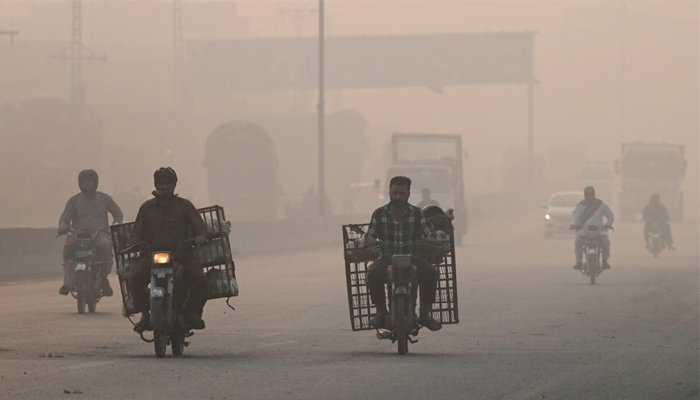
LAHORE, November 2, 2026 — Lahore has emerged as the world’s most polluted major city in IQAir’s live global air-quality ranking, with its Air Quality Index (AQI) reaching 530 on Monday morning, placing the provincial capital firmly in the hazardous category and raising fresh concerns over the health risks posed by the region’s worsening smog.
IQAir’s global ranking recorded Lahore at 530, ahead of Cairo, Egypt, at 226 and Delhi, India, at 179, in the ranking snapshot available early on November 2. The figures represent hourly readings and can change considerably throughout the day. The platform compares air quality in more than 100 major cities worldwide; it is not a ranking of every city on Earth.
A separate reading reported by Dawn, citing IQAir monitoring data, put Lahore’s AQI at 535 at 8am, with fine particulate matter (PM2.5) reaching 343 micrograms per cubic metre. The difference between the readings reflects the changing nature of air pollution and the timing of individual updates.
Fine particles pose serious health risks
The principal concern is PM2.5 — microscopic airborne particles small enough to penetrate deep into the lungs and, in some cases, enter the bloodstream. Exposure can aggravate asthma and other respiratory conditions and increase the risk of cardiovascular and respiratory illness.
An AQI reading above 300 falls into the hazardous category under the US AQI scale used by IQAir. At 530, Lahore’s reported reading was far beyond that threshold, indicating serious health risks for the wider population, not only people with existing medical conditions.
Children, older people, pregnant women and those with heart or lung conditions are particularly vulnerable. Residents are advised to reduce outdoor exposure, avoid strenuous activity outside and use a well-fitting N95 or equivalent respirator when outdoor travel is unavoidable.
Pollution spreads beyond Lahore
The worsening situation is not confined to the provincial capital. According to Dawn’s report of IQAir’s Pakistan city rankings on Monday morning, Gujranwala recorded an AQI of 606, followed by Lahore at 509, Faisalabad and Multan at 310 each, and Sialkot at 260. Peshawar was sixth at 216.
Subsequent hourly updates showed further fluctuations, with Gujranwala reaching 675 and Lahore 535 in separate readings. These variations underline the speed with which air quality can change and the importance of checking live monitoring data rather than relying on a single figure.
Crop-residue burning adds to the pollution burden
Agricultural fires are among the factors drawing renewed attention during the current smog season. An analysis published by environmental monitoring platform HamariHawa, cited by Dawn, said NASA satellite observations detected 13,241 fire spots in Pakistani Punjab between October 1 and 29, compared with 3,158 in Indian Punjab.
The analysis estimated that around 92 per cent of the detected fires in Pakistani Punjab were on farmland and were likely associated with crop-residue burning. Approximately half of the month’s detections occurred during the final seven days of October.
Okara recorded the highest number of fire detections, followed by Gujranwala and Nankana Sahib. Smoke from agricultural burning can combine with emissions from vehicles, factories, brick kilns and other sources, adding to the pollution circulating across the region.
Weather conditions can make matters worse. Weak winds and atmospheric temperature inversions may prevent polluted air from dispersing, allowing smoke and fine particles to accumulate close to the ground.
Government monitoring and enforcement
The Punjab government’s Environment Protection and Climate Change Department has been expanding its air-quality monitoring and anti-smog operations. The department’s official AQI Punjab dashboard provides provincial air-quality data, while its notifications and orders portal publishes public advisories, restrictions and enforcement-related information.
The department launched an upgraded air-quality monitoring and forecasting platform in collaboration with the International Centre for Integrated Mountain Development (ICIMOD) in September. According to ICIMOD, the system is intended to help authorities identify pollution hotspots and better understand air-quality trends across Punjab.
In a separate report published on October 30, Dawn quoted Environment Protection Department Director General Sheikh as saying that anti-smog measures, including anti-smog guns and dust-suppression operations, were being deployed according to ground conditions, particulate levels and prevailing winds. The report also detailed enforcement actions against factories, vehicles and other sources of pollution.
However, the difference between readings from government monitoring and international platforms should be kept in mind. Monitoring networks may use different stations, locations, averaging periods and calculation methods. Their figures should therefore not automatically be treated as directly interchangeable.
A brief improvement offers limited reassurance
The latest deterioration follows a period in which the Punjab government had reported improvements in Lahore’s October air quality.
However, an analysis by the Pakistan Air Quality Initiative (PAQI), reported by Dawn, offered a more cautious assessment. It found that average PM2.5 concentrations across 26 monitoring sites fell by 27 per cent compared with October 2025. After accounting for weather conditions, however, the estimated improvement was only around four per cent.
PAQI also reported that PM2.5 levels exceeded Pakistan’s prescribed daily limit on every day of October. The findings suggest that favourable weather conditions may have contributed substantially to the apparent improvement, while the underlying pollution problem remained unresolved.
A warning for residents
With November bringing renewed hazardous readings, the latest figures highlight the continuing challenge of tackling air pollution across Punjab. Controlling crop-residue burning, industrial emissions, vehicle exhaust and dust will require sustained enforcement and coordination across the region.
For residents, the immediate priority is to limit exposure. Keeping windows and doors closed when outdoor pollution is severe, using indoor HEPA air filtration where available, avoiding outdoor exercise and wearing a well-fitting N95 mask when necessary can help reduce exposure.
Lahore’s position at the top of IQAir’s global ranking is an hourly snapshot rather than a permanent title. But an AQI above 500 is a serious warning: the city’s smog problem is not merely a matter of poor visibility. It is a public-health concern that demands urgent and sustained action.
