


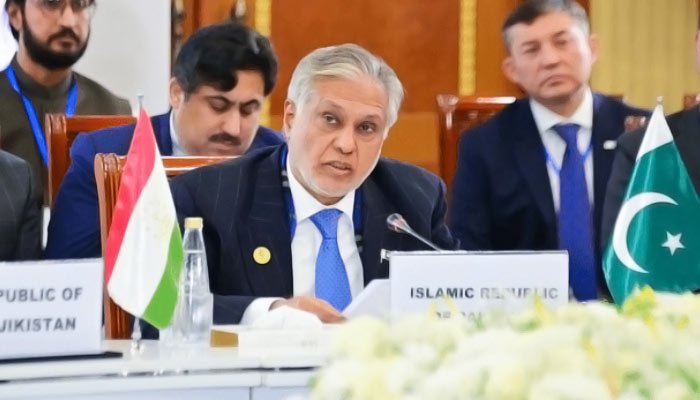
Deputy Prime Minister Ishaq Dar has stated that the joint defense agreement does not violate the United Nations Charter.
Addressing a meeting of the ECO Council of Foreign Ministers, Deputy Prime Minister Ishaq Dar noted that Article 51 of the UN Charter permits both individual and collective self-defense. A core principle of the agreement is that an attack on one member state shall be considered an attack on all member states.
He emphasized that the region should possess its own security system and architecture to ensure regional security; a joint security framework is a pressing necessity for peace and stability in the region.
The Deputy Prime Minister mentioned that a joint defense agreement between Pakistan, Saudi Arabia, and Türkiye was signed on August 7, with the inaugural meeting held in Istanbul on August 31. This trilateral agreement is founded on the principle of self-defense.
Ishaq Dar reiterated that Article 51 of the UN Charter allows for individual and collective self-defense, and that the agreement is based on the premise that an attack on one member state is an attack on all.
He explained that the objective of the agreement is to foster defense cooperation and collective security among the three nations; it should not be misconstrued as an intent by these countries to engage in confrontation with other states.
The Deputy Prime Minister added that the process of establishing an institutional framework under the agreement is currently underway. Pakistan has been entrusted with the responsibility for the initial three-year period regarding the appointments of the Secretary-General and the Chief Executive. Furthermore, a working committee—comprising a representative from the Foreign Office, three secretaries, and a representative from the military—will be established to oversee the implementation of the agreement.
