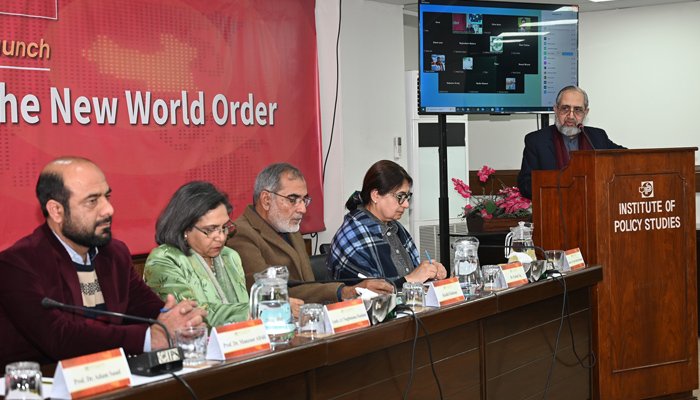
ISLAMABAD: China’s rise is not to dismantle the current global order but to reshape it, which is being made possible through gradual reforms and deeper multilateral engagement. Based on the principles of equality, non-interference, and state-led development, China is both providing opportunities to developing countries and opening up avenues for credible and lasting solutions independent of Western hegemony. This mindset has made China a key driver of the emerging multipolar order. This was noted by experts and scholars at a seminar and book launch event held at the Institute of Policy Studies (IPS), titled “China’s Globalization and the New World Order.” Speakers at the event included Khalid Rahman, Chairman IPS; Former Ambassador Syed Abrar Hussain, Vice Chairman IPS, former Ambassador Naghmana Hashmi, who served in various important countries and institutions including China, co-editors of the book, Prof. Dr. Adam Saud and Dr. Najmuddin Bakar, Prof. Dr. Manzoor Afridi, Dean of the Faculty of Social Sciences, International Islamic University, and Dr. Farhat Taj, Associate Professor, University of Tromso, Norway, were present. In his opening remarks, Ambassador Abrar Hussain highlighted the changing perspective of China on the global system. He said that China is no longer focused solely on gaining economic benefits, but is now also trying to reshape global governance, especially by focusing on the countries of the Global South and guided by the principles of equality, mutual respect, and inclusive governance. Its actions aim to advance the second wave of economic globalization and implement the Fourth Industrial Revolution. However, he said that China faces several challenges, including a shrinking domestic economy, new tariffs on high-tech exports, and geopolitical tensions. Introducing the book, Professor Adam Saud said that the work consists of 17 chapters, which offer a multifaceted and interdisciplinary analysis of China’s rise in the world system and its impact on global governance. The book goes beyond the traditional “status quo versus status quo” debate regarding China’s rise. He said that Western democracy is often presented as the global model of governance, which affects the validation of any alternative system. In contrast, China sees itself as a civilizational state that is shaped by Confucian principles and philosophies and promotes the concept of “a shared future for humanity.” Dr. Najmuddin Bakr said that China’s state-sponsored development model offers a clear ideological alternative to Western development models. In the light of Ibn Khaldun’s theory of the rise and fall of civilizations, he said that China is playing its role in reshaping global standards at both the material and intellectual levels. Naghmana Hashmi called the book an important reference for understanding China’s history, political trends and development path. According to him, the current global institutions were created for the interests of colonial or post-colonial powers, but now the rise of middle powers has exposed their structural limitations. Interestingly, the countries that were the founders of this system are now retreating from their responsibilities, while historically marginalized countries are trying to maintain it. Professor Dr. Manzoor Afridi said that the book is divided into two parts: one part is how China sees the world and the other is how the world sees China. He examined China’s evolution from the revolutionary era to its role as a country playing an integrated role on the global stage and said that today China is not seen as a threat to its neighboring countries but as a partner. Despite its growing presence, China avoids displays of power and adheres to the Five Principles of Peace. He said that the Washington Consensus, as well as the emerging Beijing Consensus, are reshaping global development through infrastructure and coordination initiatives. Dr. Farhat Taj said that this book is highly relevant for policymakers and the general public as global changes are affecting both international and domestic realities. He appreciated the efforts of the authors and co-editors and suggested areas for further research, including disinformation, hybrid warfare, and the role of non-state actors in great power competition. In his closing remarks, IPS Chairman Khalid Rehman said that China’s ability to think within its own cultural and value framework is a central factor in its rise. He said that since multipolarity is inevitable, it will provide states with multiple options and more opportunities. He also noted the growing importance of think tanks and academic institutions, which are playing a role in shaping narratives in an unstable global environment. For Pakistan, he stressed that it is important to adopt a multi-axis strategy and avoid over-reliance on any one power.

A rapidly rising China is shaping a new multipolar world order: Experts
 By News Roundup