


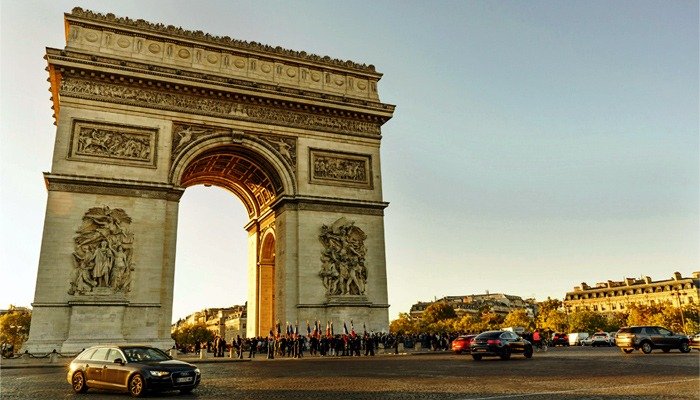
Standing at the western end of the Champs-Élysées, the Arc de Triomphe is more than a monumental arch—it is a powerful symbol of France’s national memory. Commissioned by Napoleon Bonaparte in 1806 after his victory at Austerlitz, the monument was designed to honor the soldiers who fought and died for France, especially during the Revolutionary and Napoleonic wars. Though construction spanned decades and political regimes, the Arc ultimately came to represent continuity in French history rather than a single ruler’s legacy.
Its massive stone surfaces are engraved with the names of generals and key battles, turning the monument into a permanent record of military sacrifice. Beneath the arch lies the Tomb of the Unknown Soldier, added after World War I, with an eternal flame rekindled each evening. This feature broadened the Arc’s meaning—transforming it from a celebration of victory into a solemn place of remembrance for all who gave their lives in war.
Architecturally, the Arc de Triomphe reflects neoclassical ideals inspired by ancient Roman triumphal arches, linking modern France to the legacy of classical civilization. Yet its location at the center of a twelve-avenue star (the Place Charles de Gaulle) also makes it a focal point of modern Paris, where national celebrations, protests, and moments of mourning unfold.
Today, the Arc de Triomphe stands at the crossroads of past and present. It embodies France’s struggles, sacrifices, and resilience, serving as a shared symbol of identity—one that reminds visitors and citizens alike how history, memory, and national values converge in a single, enduring monument.
